
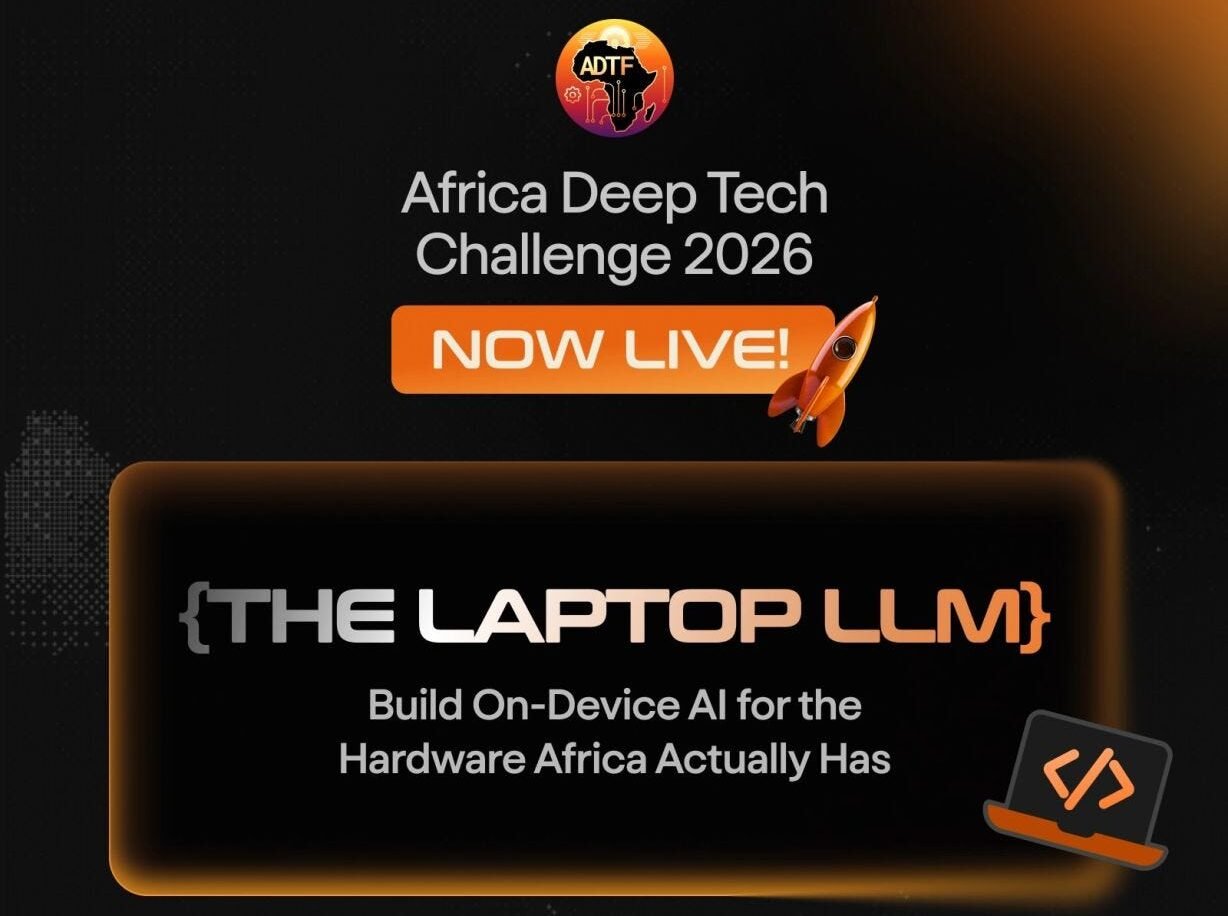
Africa Deep Tech Foundation Launchs Laptop LLM Challenge to Advance AI Innovation
The Africa Deep Tech Foundation (ADTF) has officially launched the 2026 Laptop LLM Challenge, a new initiative aimed at encouraging developers, researchers, and artificial intelligence startups across Africa to build lightweight large language models (LLMs) capable of running efficiently on standard consumer laptops.
The challenge seeks to address one of the biggest barriers to AI adoption across emerging markets, the high computational requirements needed to develop and deploy modern AI models. By focusing on compact, efficient language models that do not rely on expensive cloud infrastructure or high end graphics processing units (GPUs), the foundation hopes to make advanced AI more accessible to developers, businesses, educational institutions, and local communities throughout Africa.
The initiative also reflects the growing momentum behind Africa’s deep technology ecosystem as organizations invest in locally relevant AI research and encourage innovation designed around the continent’s unique technological realities.
Building AI for Africa’s Infrastructure
While large language models have transformed industries worldwide, many of today’s most powerful AI systems require significant computing resources that remain out of reach for many developers in Africa.
Training and deploying modern AI models often depends on costly cloud computing services or specialized hardware, creating barriers for startups, universities, and independent researchers working with limited resources.
The Laptop LLM Challenge aims to demonstrate that high-quality AI applications can be developed using smaller, optimized models capable of running directly on widely available laptops.
This approach supports broader access to AI while reducing infrastructure costs and making experimentation possible without constant internet connectivity or expensive computing environments.
Encouraging Practical AI Development
Rather than rewarding only model size or computing power, the competition emphasizes efficiency, optimization, and real-world usability.
Participants are encouraged to design language models that balance performance with resource efficiency while maintaining strong capabilities in reasoning, language understanding, and practical problem-solving.
The challenge is expected to attract software engineers, machine learning researchers, university students, startup founders, and AI communities from across the continent.
By encouraging practical engineering solutions, the foundation hopes to stimulate the development of AI systems that can be deployed in schools, businesses, healthcare facilities, financial services, agriculture, and government institutions.
Supporting Africa’s Growing AI Ecosystem
Africa’s artificial intelligence ecosystem has expanded rapidly over the past several years.
Governments, universities, research institutions, venture capital firms, and technology companies have increased investments in AI education, startup incubation, research laboratories, and open source innovation.
Developers across the continent are increasingly building AI applications tailored to African languages, local businesses, healthcare systems, financial services, education, and agriculture.
The Laptop LLM Challenge complements these efforts by focusing on one of AI’s most important infrastructure questions, how to make advanced models more efficient and accessible for environments where computing resources may be limited.
The initiative also aligns with global efforts to develop smaller language models that consume less energy while delivering strong performance across specialized tasks.
Creating Opportunities for Startups
For African AI startups, the competition presents an opportunity to showcase technical expertise while developing solutions with commercial potential.
Organizations capable of building efficient language models may find opportunities in enterprise software, education technology, healthcare, customer service automation, legal technology, and financial services.
Lightweight AI models can also provide advantages for businesses seeking greater privacy, reduced cloud costs, and faster processing by running directly on local devices.
As demand for AI applications continues to grow across Africa, companies capable of delivering efficient solutions could gain a competitive advantage in markets where affordability and accessibility remain essential.
Advancing Open Innovation
The challenge also reinforces the importance of collaboration within Africa’s growing deep technology community.
Competitions like the Laptop LLM Challenge encourage knowledge sharing, technical experimentation, and collaboration between startups, researchers, developers, and academic institutions.
They also provide emerging talent with opportunities to demonstrate their capabilities while contributing to technologies that address local needs.
By supporting open innovation, the Africa Deep Tech Foundation aims to strengthen the continent’s AI ecosystem and position African developers as contributors to global advances in artificial intelligence.
Looking Ahead
As AI becomes increasingly integrated into industries worldwide, demand for efficient, affordable, and locally deployable models is expected to grow.
The 2026 Laptop LLM Challenge could inspire a new generation of African AI solutions designed specifically for environments where computing resources are limited but innovation remains abundant.
The competition also highlights an important shift within artificial intelligence, from building only larger models to developing smarter, more efficient systems that can reach more people.
For Africa’s growing community of developers and AI entrepreneurs, the challenge represents an opportunity to demonstrate that world-class innovation can be achieved through optimization, creativity, and practical engineering rather than computational scale alone.
EIA Takeaway
The Africa Deep Tech Foundation’s Laptop LLM Challenge reflects a growing recognition that the future of artificial intelligence will not be defined solely by larger models, but by more accessible ones. By encouraging developers to build efficient language models that run on everyday laptops, the initiative lowers barriers to AI innovation and broadens participation across the continent. As African startups increasingly develop technologies tailored to local needs, competitions like this can help cultivate technical talent, accelerate commercialization, and strengthen Africa’s position in the global AI ecosystem.